Gold in the Shebandowan Greenstone Belt
Regional geology · Northwestern Ontario
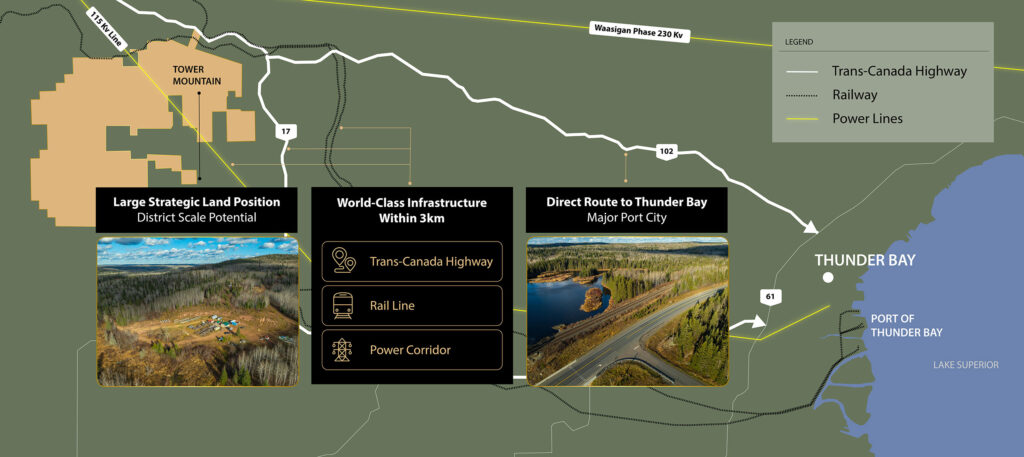
The Shebandowan Greenstone Belt is an Archean volcanic package about 40 km west of Thunder Bay, Ontario, and it hosts Thunder Gold’s Tower Mountain project. This page explains what a greenstone belt is, why these belts concentrate gold, and what to check in any project inside one.
Archean
older than 2.5 billion years
40 km
west of Thunder Bay, Ontario
3.5 Moz
contained gold at Tower Mountain
01
What Is a Greenstone Belt?
A greenstone belt is a long, narrow belt of ancient volcanic and sedimentary rocks metamorphosed at low grade, which gives the rocks a characteristic green colour and the belt its name. Most are Archean, older than 2.5 billion years, and they preserve the remnants of volcanic arcs, ocean floor and sedimentary basins assembled during early crustal growth.
Internally they are a layered mix of mafic and ultramafic flows, intermediate to felsic volcanic rocks, volcaniclastic and sedimentary units, and later granitoid intrusions. That mix, deformed by faults and folds, created the plumbing that gold-bearing fluids later exploited.
02
Why Greenstone Belts Host So Much Gold
Three ingredients explain the concentration. The volcanic sequences began enriched in gold relative to average crust. Deformation created long-lived, deeply penetrating structures that focused fluid flow for millions of years. Syn- to post-tectonic intrusions supplied heat and, in some systems, magmatic fluid.
Where the three combine, gold is stripped from large volumes of rock and re-deposited in structurally prepared traps: shear zones, fold hinges, competency contrasts and alteration halos. Time matters too, because these belts have been re-activated repeatedly, and each deformation event re-opens pathways and concentrates gold further. The result is a family of deposits rather than a single type.
03
Two Families: Orogenic and Intrusion-Related
Orogenic gold deposits form from metamorphic fluids in and around major shear zones, with gold in quartz-carbonate veins and their altered wall rock. They do not require an intrusion. Intrusion-related deposits are driven by cooling magmas, with gold in disseminated sulphide, sheeted veins and breccia systems around or within the intrusive body.
Where the three combine, gold is stripped from large volumes of rock and re-deposited in structurally prepared traps: shear zones, fold hinges, competency contrasts and alteration halos. The result is a family of deposits rather than a single type.
04
The Shebandowan Greenstone Belt
The Shebandowan Greenstone Belt lies in the Wawa subprovince of the Superior Province, west of Thunder Bay. Its rocks belong to the Shebandowan Assemblage: Archean volcanic and volcaniclastic units intruded by later granitoid bodies, including the Tower Mountain Intrusive Complex, which Thunder Gold describes as the largest exposed calc-alkalic intrusive complex in the eastern part of the belt.
Major east-west trending deformation zones pass through the Shebandowan Greenstone Belt, and the contact between the intrusive complex and the volcanic package is where fluid pathways and chemical contrasts were strongest. That is the setting for intrusion-related gold.
05
What to Check in Any Greenstone Project
What is the host-rock package, and is it a favourable volcanic or volcaniclastic unit? What structure controls the mineralisation, and how continuous is it? Is there an intrusion, and does the alteration halo extend beyond the drilled area?
Greenstone belts are also where historic production and modern exploration overlap. Old mines give geologists shallow showings to test at depth, and assessment files often contain assays that were never followed up.
Greenstone belts are also where historic production and modern exploration overlap. Old mines and prospects give geologists shallow showings to test at depth, and government assessment files often contain assays that were never followed up.
Host-rock package and its chemistry.
Structural setting and the continuity of the controlling structure.
Alteration footprint, including magnetic or geochemical vectors.
Drill density and the Indicated versus Inferred split.
Metallurgical recovery and any deleterious elements.
06
Where Tower Mountain Fits
Tower Mountain is an intrusion-related system hosted in carbonate-sericite-chlorite alteration around the intrusive complex, and it sits inside the Shebandowan Greenstone Belt. The January 19, 2026 estimate by Micon International Limited reports 34.0 Mt Indicated at 0.46 g/t Au and 211.1 Mt Inferred at 0.45 g/t Au, about 3.5 Moz in total, with no Measured resources.
Within the Shebandowan Greenstone Belt that is a large footprint for a single project, and most of the complex perimeter remains untested.
Because the belt is well mapped, exploration can be targeted from public geoscience rather than guesswork. That is the practical advantage of working in a known district: the regional framework is already published, so money goes into testing rather than into basic mapping.
That is a large footprint for a single project inside the Shebandowan Greenstone Belt, and most of the complex perimeter remains untested.
Questions
Frequently Asked Questions
In the Wawa subprovince of the Superior Province, west of Thunder Bay in Northwestern Ontario. Thunder Gold’s Tower Mountain project sits about 40 km west of the city.
Gold-enriched volcanic sequences, long-lived deep structures that focused fluid flow, and syn- to post-tectonic intrusions that supplied heat. Where those combine, gold is stripped from large volumes of rock and trapped in shear zones and alteration halos, as in the Shebandowan Greenstone Belt.
Orogenic deposits form from metamorphic fluids around major shear zones and do not require an intrusion. Intrusion-related deposits are driven by cooling magmas, with gold in disseminated sulphide and vein systems around or inside the intrusive body. Both styles occur in the Shebandowan Greenstone Belt.
The January 19, 2026 Micon International estimate reports 34.0 Mt Indicated at 0.46 g/t Au and 211.1 Mt Inferred at 0.45 g/t Au, about 3.5 Moz, with no Measured resources.
Archean, older than 2.5 billion years. Magmatic-hydrothermal events in the Tower Mountain Intrusive Complex are dated at 2692 to 2689 Ma.
See how the belt geology becomes a resource
The Tower Mountain geology page connects the Shebandowan Greenstone Belt setting to the alteration, pyrite and drill results behind the estimate.
Prepared by Thunder Gold Corp. Statements about mineral resources refer to the January 19, 2026 NI 43-101 estimate by Micon International Limited. Mineral resources are not mineral reserves and have not demonstrated economic viability. Last updated: 2 November 2026.