Tower Mountain Geology: An Intrusion-Related Gold System
Geology · Shebandowan Greenstone Belt, Ontario
Tower Mountain geology is the reason the project holds a bulk-tonnage deposit rather than a narrow vein. Gold sits in altered Archean rocks wrapping a multi-phase intrusive complex, and the alteration halo is what gives the system its scale.
2692–2689 Ma
age of the magmatic-hydrothermal events
500 m+
extent of CSC alteration west of the contact
3.5 Moz
contained gold in the 2026 estimate
01
A Bulk-Tonnage, Low-Grade Disseminated System
Tower Mountain is a bulk-tonnage, low-grade disseminated gold deposit. The gold does not sit in narrow quartz veins; it is scattered through broad zones of altered rock, largely as fine-grained native gold associated with pyrite. That style of mineralisation is what allows long, continuous drill intercepts measured in hundreds of metres rather than grams over a single metre.
The deposit belongs to the intrusion-related gold family: a magmatic-hydrothermal system in which heat and fluids from an intrusive complex altered the surrounding rocks and deposited gold. Reading Tower Mountain geology means reading that relationship between intrusion, alteration and gold.
The practical consequence is scale. Narrow-vein deposits need many closely spaced veins to build tonnage, while a disseminated halo lets one long hole test hundreds of metres of rock. That is why Tower Mountain intercepts are measured in hundreds of metres and why the model covers a large volume at a modest grade.
02
Tower Mountain Geology: The Intrusive Complex
The complex is multi-phase. It comprises syenites, monzonites, diorites and gabbro, with magmatic-hydrothermal events dated at 2692 to 2689 Ma. The host rocks are Archean volcanic, volcanoclastic and intrusive rocks of the Shebandowan Assemblage.
A large, multi-phase calc-alkalic intrusion emplaced into favourable volcanic rocks is the classic setting for intrusion-related gold in Archean terranes. Thunder Gold describes the complex as the largest exposed calc-alkalic intrusive complex in the eastern Shebandowan Greenstone Belt, which is the central fact of Tower Mountain geology.
03
Tower Mountain Geology: Why the Contact Hosts the Gold
Gold is concentrated along and near the contact between the intrusive complex and the surrounding volcanic package. The contact is where fluid pathways and chemical contrasts were strongest, which is why mineralisation forms haloes around the intrusion rather than sitting in one narrow vein.
That also explains why the Company returns to the contact with new fences of drill holes, and why the current resource footprint follows about 1,800 metres of it. In Tower Mountain geology, the contact is the structure that organises everything else.
04
Carbonate-Sericite-Chlorite Alteration
Gold at Tower Mountain is hosted in carbonate-sericite-chlorite alteration. The altered halo extends more than 500 metres west of the intrusive contact and remains open, which is one reason the deposit is not treated as closed off. For anyone reading Tower Mountain geology, the open halo is the most important line on the map.
The alteration also had a physical side effect geologists can map from the air: it destroyed magnetite in the host rocks. Magnetite destruction produces broad magnetic lows, and those lows are a direct exploration vector. Magnetic surveys therefore trace the alteration footprint far beyond the drilled area, which is why Tower Mountain geology and geophysics are read together.
05
Pyrite Tracks the Gold Grade
Pyrite is the key sulphide. It occurs as fine, disseminated grains rather than massive sulphide zones, and its abundance correlates directly with gold grade. In Tower Mountain geology, pyrite is the field indicator a geologist can see before assays return.
That correlation is also why the logging is worth reading in a technical report: it is an independent check on the assay database, and it supports the geological model used to constrain the estimate.
That relationship is also a constraint. Where pyrite is absent, grade tends to fall away, so the model uses logged pyrite and alteration as domaining controls rather than relying on assays alone.
06
Categories and What They Mean
The 2026 estimate sorts the deposit into two confidence categories. Indicated resources are those where geological evidence and sampling are detailed enough to assume continuity with reasonable confidence. Inferred resources carry lower confidence: continuity is assumed but not verified, and Inferred material cannot be converted to a reserve on its own.
The January 2026 estimate reports no Measured resources, and no part of it is a Mineral Reserve. Those distinctions are defined by the CIM standards and enforced through NI 43-101 reporting.
The alteration halo can be mapped from airborne magnetic data, which is why surveys cover the whole complex rather than only the drilled ground.
Questions
Frequently Asked Questions
An intrusion-related gold system: a bulk-tonnage, low-grade deposit where gold is disseminated in altered Archean volcanic and intrusive rocks around a multi-phase intrusive complex. That is the short version of Tower Mountain geology.
Carbonate-sericite-chlorite alteration, the halo that hosts gold at Tower Mountain. It extends more than 500 m west of the intrusive contact, remains open, and destroyed magnetite, which is why it shows up as magnetic lows.
Magmatic-hydrothermal events in the Tower Mountain Intrusive Complex are dated at 2692 to 2689 Ma, within the Archean Shebandowan Assemblage.
Because pyrite abundance correlates directly with gold grade. A geologist logging core can estimate prospectivity from pyrite content before assay results arrive, and it provides an independent check on the assay database.
A narrow-vein mine depends on a small number of high-grade structures. At Tower Mountain the gold is disseminated through a large altered volume, so tonnage comes from width and continuity rather than from a few very high grades.
See the core behind the geology
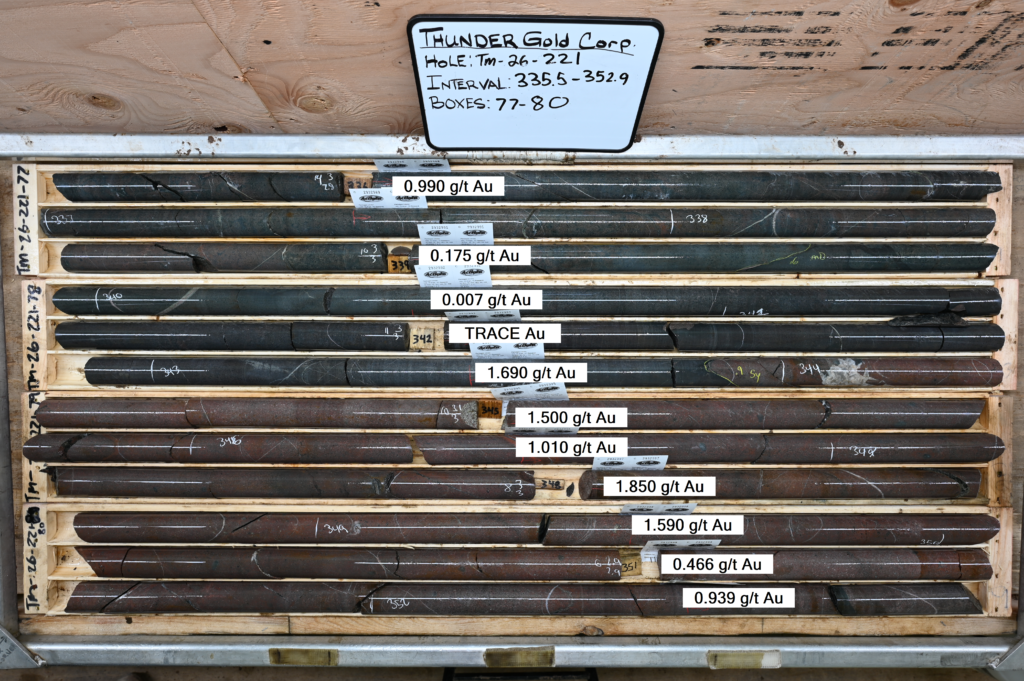
Photographs of logged core from the 2026 programme show the alteration and pyrite that Tower Mountain geology is interpreted from.
Prepared by Thunder Gold Corp. Statements about mineral resources refer to the January 19, 2026 NI 43-101 estimate by Micon International Limited. Mineral resources are not mineral reserves and have not demonstrated economic viability. Last updated: 2 November 2026.