Gold Exploration in Ontario: Projects, Deposits and Companies
Jurisdiction · Ontario, Canada
Gold exploration in Ontario accounts for a large share of Canada’s exploration spending, and the reason is geological: Archean greenstone belts run across the province, hosting some of the country’s best-known gold camps. This page explains the districts, the rules and the economics.
3.5 Moz
defined at Tower Mountain, Ontario
C$215,000
Ontario Junior Exploration Program award, 2026
40 km
west of Thunder Bay
01
Why Ontario Holds So Much Gold
Ontario sits on the Superior Province, an Archean craton assembled more than 2.5 billion years ago. Within it, greenstone belts preserve volcanic sequences that were enriched in gold, deformed by long-lived structures and intruded by later granitoid bodies.
That combination produced the Abitibi belt in the northeast, the Red Lake camp in the northwest, and the Shebandowan belt west of Thunder Bay, among others. Much of gold exploration in Ontario is the business of testing those belts with modern methods.
02
The Main Districts
The Abitibi Greenstone Belt is the largest continuous Archean greenstone belt in the world and hosts Timmins, Kirkland Lake and Detour among others, which is where most gold exploration in Ontario has historically concentrated. Red Lake is a high-grade camp with a long production history. The Shebandowan belt, where Thunder Gold works, is smaller but structurally comparable, with east-west deformation zones and intrusion-related systems, and it is the part of gold exploration in Ontario this site documents.
Each district has its own character, and each has shaped how gold exploration in Ontario is funded today. Abitibi deposits are frequently orogenic and structurally controlled; Red Lake is known for high-grade veins; Shebandowan hosts intrusion-related systems around calc-alkalic complexes.
Abitibi: large-scale orogenic systems, extensive infrastructure.
Red Lake: high-grade vein systems with a long history.
Shebandowan: intrusion-related gold around the Tower Mountain Intrusive Complex.
Wawa and Hemlo: additional belts with distinct deposit styles.
03
Rules and Permitting
Exploration in Ontario runs under the Mining Act, with claim staking and assessment work requirements. Exploration on Crown land also brings consultation duties, including with First Nations, and the Tower Mountain property lies in the traditional territories of Fort William First Nation.
Disclosure adds a second layer: NI 43-101 requires technical reports prepared or supervised by Qualified Persons, and public filing of the supporting documents. That is why gold exploration in Ontario produces a paper trail a reader can follow.
04
The Economics of Exploring in Ontario
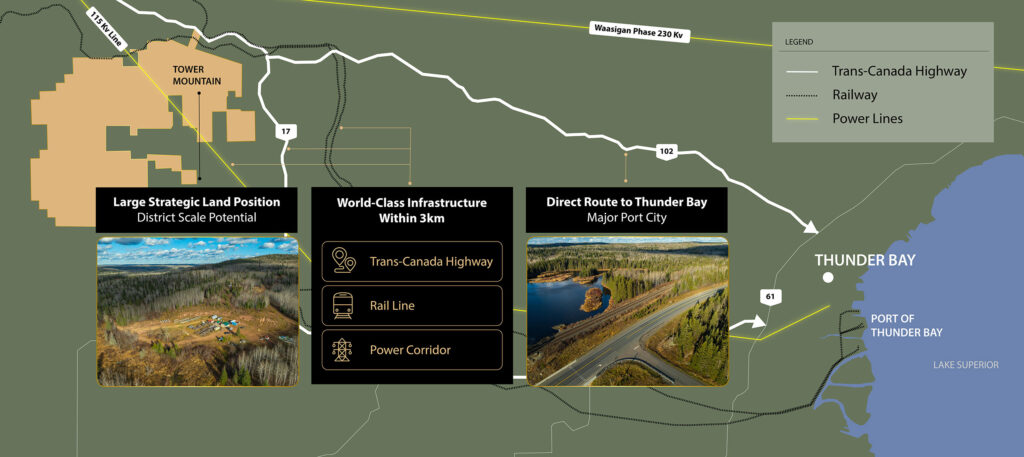
Infrastructure is the quiet advantage in gold exploration in Ontario. A project near a highway, rail line and power corridor can be drilled year-round by crews who live in a city; a remote camp cannot. Those differences appear in cost per metre and later in capital estimates.
At Tower Mountain the boundary lies about 3 km south of the Trans-Canada Highway 11/17, roughly 40 km from Thunder Bay, and the Company reports all-in drilling costs of about C$250 to C$275 per metre.
Provincial support matters too. The Ontario Junior Exploration Program awarded Thunder Gold C$215,000 in March 2026, which offsets part of the cost of a drilling programme.
05
Where Tower Mountain Fits
Tower Mountain is an intrusion-related gold system in the Shebandowan Greenstone Belt, about 40 km west of Thunder Bay. The January 19, 2026 estimate by Micon International Limited reports 34.0 Mt Indicated at 0.46 g/t Au and 211.1 Mt Inferred at 0.45 g/t Au, about 3.5 Moz, with no Measured resources.
Gold exploration in Ontario is competitive for capital, and a project with infrastructure, a filed estimate and a funded programme is easier to compare with its peers than one without.
06
What to Check in an Ontario Project
The checks are the same as anywhere, with a provincial twist: confirm the claims are in good standing, confirm the assessment work has been filed, and confirm who prepared any resource estimate. Then ask about infrastructure distance and the drill cost per metre.
Those four answers separate an Ontario project with a case from a story with a map, and they are the same questions that apply to gold exploration in Ontario more broadly.
07
How Ontario Projects Get Funded
Equity financing dominates, and in Canada flow-through shares allow investors to claim certain exploration expenses against tax. Provincial programmes add a second layer, and the Ontario Junior Exploration Program awarded Thunder Gold C$215,000 in March 2026.
The practical effect is that drill programmes are funded in tranches, so financings usually precede metres.
08
Reading an Ontario Resource Estimate
Ontario estimates follow NI 43-101, so the same questions apply province-wide: who prepared it, what cut-off was used, how much is Indicated rather than Inferred, and what assumptions sit underneath. A pit-constrained estimate at a stated gold price is a snapshot, not a permanent value.
Those questions travel well. They work on Tower Mountain and they work on any other Ontario project a reader is comparing it with.
The Shebandowan belt, where Thunder Gold works, is the part of gold exploration in Ontario this site documents in most detail.
Questions
Frequently Asked Questions
Archean greenstone belts with gold-enriched volcanic sequences, long-lived deformation zones, existing infrastructure and a defined permitting path under the Mining Act. Those factors are why gold exploration in Ontario attracts so much spending.
The Abitibi belt including Timmins and Kirkland Lake, the Red Lake camp, the Shebandowan belt west of Thunder Bay, and the Wawa and Hemlo areas, each with a distinct deposit style.
Yes. The Ontario Junior Exploration Program awarded Thunder Gold C$215,000 in March 2026. The programme is competitive and offsets part of the cost of eligible work.
The January 19, 2026 Micon International estimate reports 34.0 Mt Indicated at 0.46 g/t Au and 211.1 Mt Inferred at 0.45 g/t Au, about 3.5 Moz, with no Measured resources.
Mostly through equity financings, often flow-through shares, plus provincial programmes such as the Ontario Junior Exploration Program. Companies typically fund drilling in tranches.
See the Ontario project in detail
Tower Mountain shows the district geology, the infrastructure and the resource estimate in one place.
Prepared by Thunder Gold Corp. Statements about mineral resources refer to the January 19, 2026 NI 43-101 estimate by Micon International Limited. Mineral resources are not mineral reserves and have not demonstrated economic viability. Last updated: 2 November 2026.