Gold Exploration Companies in Canada: A Due Diligence Framework
Company comparison · Canadian juniors
Comparing gold exploration companies in Canada comes down to measurable things: where the ground sits, what the resource contains, what drilling costs and who is paying for it. This page sets out a due diligence framework you can apply to any Canadian junior, with Thunder Gold Corp. as the worked example.
3.5 Moz
contained gold at Tower Mountain
1.8:1
strip ratio reported by the Company
C$250–275
all-in drilling cost per metre
01
What a Canadian Gold Exploration Company Actually Does
The job is a sequence of de-risking steps rather than a single activity. A junior starts with ground selection, staking or optioning claims, then compiles historical data before spending money on new fieldwork. Government geoscience and old drill logs are inexpensive; new surveys and holes are not. Most gold exploration companies in Canada follow the same order of work.
At Tower Mountain that sequence now runs to roughly 235 drill holes and about 47,000 metres.
Acquiring ground and verifying title, including claim and patent records.
Compiling historical and government data before committing to fieldwork.
Geophysical surveys to map structure, alteration and magnetic response.
Diamond drilling, assaying under a QA/QC programme, then a geological model.
An independent mineral resource estimate to NI 43-101 standards.
02
Why Canada Hosts So Many Gold Juniors
Four structural reasons keep Canada central to the sector. Archean greenstone belts in Ontario and Quebec, including the Abitibi, Red Lake and Shebandowan belts, host abundant gold systems at relatively shallow depth. NI 43-101 imposes technical reporting rules, accountability on qualified persons and public filing on SEDAR+.
Capital comes third: TSX Venture Exchange listings, flow-through share incentives and a deep pool of specialist resource funds. Provincial programmes add support, and the Ontario Junior Exploration Program awarded Thunder Gold C$215,000 in March 2026. Access to that capital is why gold exploration companies in Canada can fund multi-year programmes.
03
How Infrastructure Changes Exploration Economics
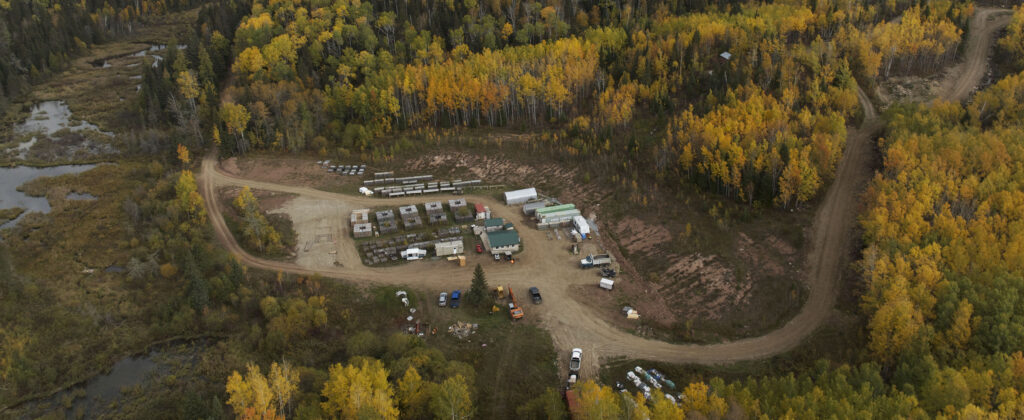
Where a project sits shapes what it costs to explore. A property beside a highway, a rail line and a power corridor can be drilled year-round by crews who live in a nearby city; a remote camp needs aviation support, winter roads, accommodation and catering. Those differences show up in cost per metre and, later, in capital estimates.
Thunder Gold’s boundary lies about 3 km south of the Trans-Canada Highway 11/17, roughly 40 km from a city of about 110,000 people, with the international port of Thunder Bay available for logistics. The Company reports all-in drilling costs of about C$250 to C$275 per metre, a range that separates efficient gold exploration companies in Canada from remote-camp peers.
04
Gold Exploration Companies in Canada: The Disclosure Chain
Everything a listed company says technically should trace back to a filed document. Read the record in this order.
Start with the investor presentation for orientation.
Read the technical report and its resource table, and check the effective date.
Cross-check drill intercepts against the releases that announced them.
Read the financial statements and management discussion for cash and spending.
Confirm who runs the company: discoveries are made by people, not acreage.
05
Comparing Peers on Strip Ratio
Strip ratio is the tonnes of waste rock moved for every tonne of mineralised material, and it lets a reader compare very different projects in one jurisdiction. Thunder Gold reports 1.8:1 at Tower Mountain. Among Canadian peers, Spanish Mountain reports 2.0:1, Springpole 3.0:1, Troilus 3.1:1, Moss Lake 5.3:1, Fenn-GIB 6.0:1 and Novador 7.4:1, according to Atrium Research. A lower ratio means less waste for each tonne processed, which can reduce mining cost per tonne, other assumptions being equal. It is the one metric that lets a reader rank gold exploration companies in Canada on like-for-like terms.
Thunder Gold also reports a discovery cost of C$3.95 per ounce and a January 19, 2026 resource of 34.0 Mt Indicated at 0.46 g/t Au plus 211.1 Mt Inferred at 0.45 g/t Au.
06
What a Junior Cannot Claim
A junior cannot describe a project as a mine, a mineral reserve or a source of revenue until independent studies and permitting support it. Mineral resources are not mineral reserves and do not have demonstrated economic viability. Independent review is the safeguard: the Tower Mountain estimate was prepared by qualified persons at Micon International Limited, not by the Company.
Current work is resource definition and expansion, with 15,000 to 25,000 metres planned for 2026, a resource update targeted for Q4 2026 and an initial PEA targeted for Q4 2026 or Q1 2027. Those are targets, not outcomes, and they are the milestones to judge gold exploration companies in Canada against.
Questions
Frequently Asked Questions
A company that acquires mineral rights in Canada, explores them through mapping, geophysics, geochemistry and drilling, and defines mineral resources to NI 43-101 standards without operating a mine. Thunder Gold Corp. is an example, focused on Tower Mountain near Thunder Bay, Ontario.
Canada combines prospective Archean greenstone belts, a strict NI 43-101 disclosure regime, a deep capital market through the TSX Venture Exchange, flow-through share incentives and provincial funding such as the Ontario Junior Exploration Program. That mix is why so many gold exploration companies in Canada are listed in Toronto.
The January 19, 2026 Micon International Limited estimate reported 34.0 Mt Indicated at 0.46 g/t Au for 514,000 ounces and 211.1 Mt Inferred at 0.45 g/t Au for 3,053,000 ounces, roughly 3.5 million ounces, with no Measured resources.
No. Mineral resources are not mineral reserves and do not have demonstrated economic viability. A mine requires feasibility-level studies, permitting under the Ontario Mining Act, financing and construction. Thunder Gold is targeting an initial PEA in Q4 2026 or Q1 2027, which is a stated target, and that distinction applies to all gold exploration companies in Canada.
Apply the framework to one company
Thunder Gold publishes its resource estimate, drilling costs and disclosure record for exactly this kind of review by anyone comparing gold exploration companies in Canada.
Prepared by Thunder Gold Corp. Statements about mineral resources refer to the January 19, 2026 NI 43-101 estimate by Micon International Limited. Mineral resources are not mineral reserves and have not demonstrated economic viability. Last updated: 2 November 2026.