Gold Exploration Investment Opportunities: A Practical Framework
Investor framework · How to evaluate a junior
Gold exploration investing rewards a repeatable process more than a strong opinion. This page sets out the checks that matter for a junior explorer, the risks that are easy to miss, and how the Tower Mountain project measures against them.
C$3.95
discovery cost per ounce, Tower Mountain
1.8:1
strip ratio reported by the Company
3.5 Moz
contained gold defined so far
01
Start With What Is Owned
Every evaluation begins with the ground: what the company owns, whether title is verified, and whether the claims are in good standing. A resource estimate on ground with a title problem is not an asset.
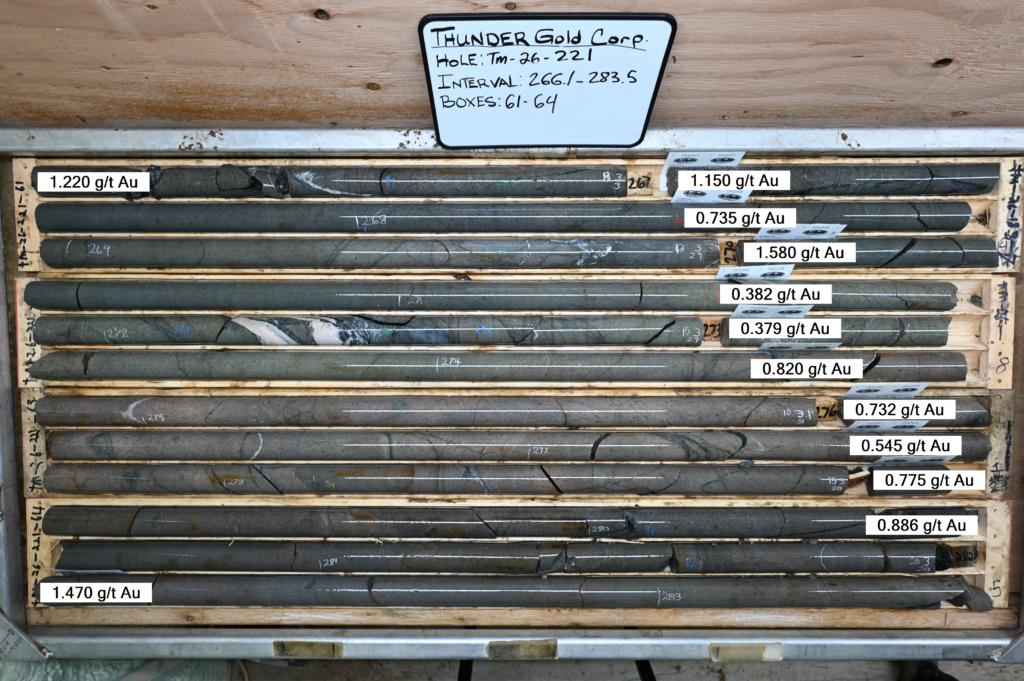
Thunder Gold owns 100% of Tower Mountain, roughly 7,000 hectares around the Tower Mountain Intrusive Complex in the Shebandowan Greenstone Belt, about 40 km west of Thunder Bay, Ontario. Title and ownership are the foundation of any gold exploration investing case.
02
Judge the Resource, Not the Headline
Size, grade, category and cut-off matter together. A large Inferred resource is a different asset from a smaller Indicated one, and a low-grade bulk system is a different business from a high-grade narrow vein.
At Tower Mountain the January 19, 2026 estimate by Micon International Limited reports 34.0 Mt Indicated at 0.46 g/t Au and 211.1 Mt Inferred at 0.45 g/t Au, about 3.5 Moz, at a 0.19 g/t Au cut-off. There are no Measured resources, which is the normal position for a project at this stage of gold exploration investing.
03
Cost per Metre and Cost per Ounce
Two cost figures separate efficient explorers from expensive ones, and they are the first numbers serious gold exploration investing looks at. All-in drilling cost per metre shows how much ground can be tested per dollar. Discovery cost per ounce shows how much it cost to find what has been defined.
Thunder Gold reports all-in drilling costs of about C$250 to C$275 per metre and a discovery cost of C$3.95 per ounce. Both are the kind of figures a reader can compare across companies, provided the basis of calculation is disclosed.
Cost figures are only comparable when the definition is consistent. Ask whether the number includes assays, logistics and overhead, or only the rig.
04
Dilution and Funding
Junior explorers fund work by issuing equity, and any review of gold exploration investing should be judged on how much dilution paid for the work. Options, warrants and flow-through financings all change the fully diluted count.
A useful habit is to divide the money raised by the metres funded. That ratio, compared across companies, says more about capital efficiency than any single financing announcement.
05
Management and Track Record
Deposits are found by people, which is why management is weighted heavily in any gold exploration investing framework. A team with a discovery record, operating experience in the jurisdiction, and a clear technical rationale is worth more than acreage alone.
The same logic applies to the professionals who sign the reports. At Tower Mountain the Qualified Persons are William Lewis, P.Geo.; Charley Murahwi, P.Geo., FAusIMM; and Tudorel Ciuculescu, P.Geo., of Micon International Limited.
06
Catalysts and Timeline
A catalyst is a dated event that changes the information available: an assay batch, a resource update, a study. Without dates, a thesis has no way to be proved wrong.
Thunder Gold has stated targets of an updated resource estimate in Q4 2026 and an initial PEA in Q4 2026 or Q1 2027, backed by 15,000 to 25,000 metres of drilling in 2026. Those are targets, not commitments, and the release list shows what has actually been delivered, which is the discipline gold exploration investing demands.
07
The Risks Worth Naming
Financing risk, technical risk and execution risk apply to every junior. Gold exploration investing adds a fourth: price risk, because a lower gold price removes tonnes from a pit-constrained estimate and can make a marginal project uneconomic.
They can be sized, which is what a framework is for.
08
Sizing a Position and Naming the Risk
Exploration is a portfolio business because most individual projects fail. Sizing a position so that a total loss is survivable is the first decision, and it comes before any view on a specific company.
The second decision is what would change the thesis. If a drill programme returns nothing, or a financing arrives at a heavy discount, the thesis has changed and the position should be reviewed rather than defended.
09
When to Re-read the Thesis
Every new release is a chance to check whether the original reasons still hold. More metres in the same place with the same grades is progress. A change in strategy, a departure of key people or a financing that funds overhead instead of drilling is a signal to look again.
Gold exploration investing is mostly the discipline of updating on evidence rather than on enthusiasm.
Questions
Frequently Asked Questions
Title to the ground, who prepared the resource estimate and when, the Indicated versus Inferred split, drilling and discovery costs, the fully diluted share count, management track record and dated catalysts. Those checks are the basis of any gold exploration investing decision.
Total exploration spending divided by the ounces defined. Thunder Gold reports C$3.95 per ounce at Tower Mountain. It is only comparable when companies calculate it the same way.
It measures waste rock moved per tonne of mineralised material. A lower ratio can reduce mining cost per tonne. Thunder Gold reports 1.8:1 at Tower Mountain.
No. This page is general information about how to evaluate exploration companies. Mineral resources are not mineral reserves, and nothing here is a recommendation.
The framework scales: a handful can be tracked properly, and more than that usually means reading headlines rather than disclosures. Depth matters more than coverage.
Apply the framework to Tower Mountain
The project page carries the resource, the costs and the timeline in one place, which is what gold exploration investing depends on.
Prepared by Thunder Gold Corp. Statements about mineral resources refer to the January 19, 2026 NI 43-101 estimate by Micon International Limited. Mineral resources are not mineral reserves and have not demonstrated economic viability. Not investment advice. Last updated: 2 November 2026.