
Gold Exploration Near Thunder Bay, Ontario
District · Northwestern Ontario
Thunder Bay is the service centre for a large stretch of Northwestern Ontario, and the rocks west of the city are Archean greenstone belt terrain. That combination of geology and infrastructure is why gold exploration near Thunder Bay is practical rather than heroic.
~110,000
population of Thunder Bay
40 km
from the city to Tower Mountain
3 km
from the property to Highway 11/17
01
Why the District Works
Thunder Bay sits at the western end of Lake Superior, at the head of the Great Lakes navigation system. It has an international port, two rail corridors, an airport and a workforce that already understands mining, forestry and heavy industry.
The geology adds the other half. Archean greenstone belts extend west and northwest of the city, including the Shebandowan belt, where several intrusion-related and orogenic gold systems have been identified.
02
The Shebandowan Belt
The Shebandowan Greenstone Belt lies in the Wawa subprovince of the Superior Province. Its rocks belong to the Shebandowan Assemblage: Archean volcanic and volcaniclastic units intruded by later granitoid bodies, including the Tower Mountain Intrusive Complex.
Gold exploration near Thunder Bay is shaped by that belt. Major east-west deformation zones pass through it, and the contact between intrusive and volcanic rocks is where fluid pathways and chemical contrasts were strongest.
03
Infrastructure and Cost
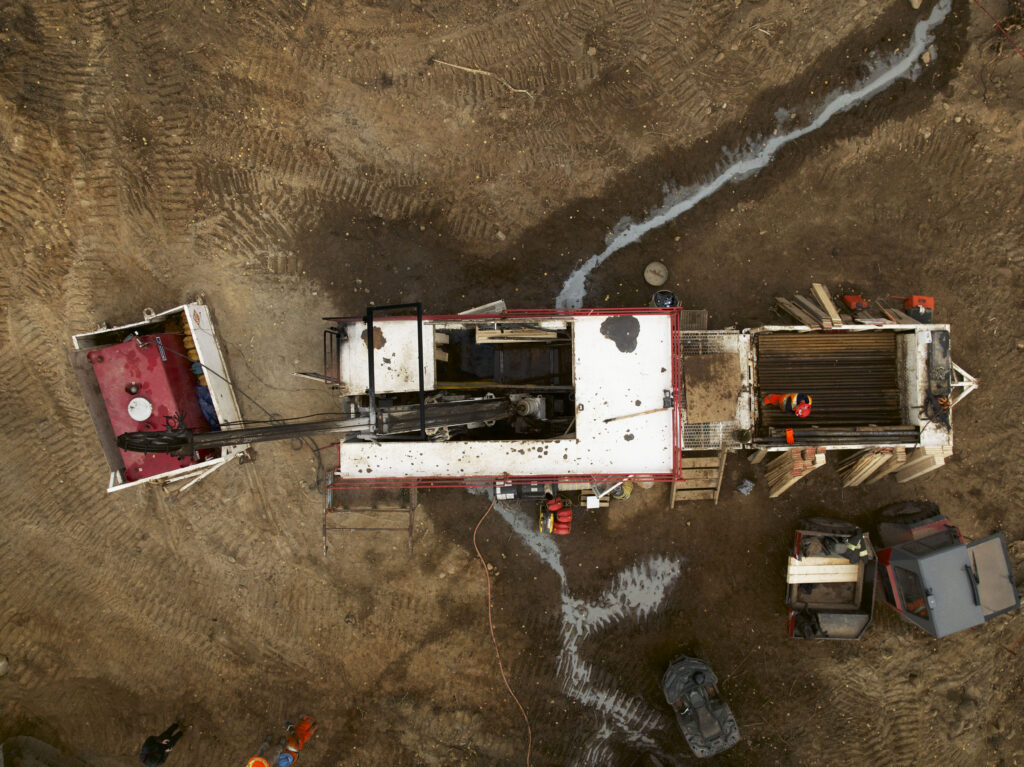
Infrastructure changes what exploration costs. A property near a highway, rail line and power corridor can be drilled year-round by crews who go home at night; a remote camp needs aviation support, winter roads, accommodation and catering.
The Tower Mountain property boundary lies about 3 km south of the Trans-Canada Highway 11/17, with rail and power corridors 3 to 5 km away and the port available for future logistics. The Company reports all-in drilling costs of about C$250 to C$275 per metre.
04
The Workforce Advantage
A camp costs money to build, staff and supply. A city of about 110,000 people supplies geologists, technicians, contractors, laboratories and drill crews who can be at a property within an hour.
That matters over a multi-year programme. Assay turnaround, equipment repair and crew rotation all improve when the project is close to services, and those improvements show up in cost per metre rather than in a press release.
05
What Has Been Found
At Tower Mountain, the January 19, 2026 estimate by Micon International Limited reports 34.0 Mt Indicated at 0.46 g/t Au and 211.1 Mt Inferred at 0.45 g/t Au, about 3.5 Moz in total, with no Measured resources and no reserves.
The deposit is intrusion-related, hosted in carbonate-sericite-chlorite alteration around the Tower Mountain Intrusive Complex. Gold exploration near Thunder Bay continues to test similar contacts across the belt.
06
Consultation and Permitting
The property lies in the traditional territories of Fort William First Nation, and exploration on Crown land brings consultation duties alongside the technical work. Permitting for any future mine would run through the Ontario Mining Act.
Those obligations are part of doing business in the district, and they are visible in disclosure rather than hidden in it.
Mineral resources are not mineral reserves and do not have demonstrated economic viability. Any future development requires studies, permitting and financing.
07
Getting There
Thunder Bay is on the Trans-Canada Highway and has an airport with scheduled service, which matters for crews, consultants and core delivery. A property an hour from the city can be visited and left in a day.
That geography shortens decision cycles. A geologist can look at core in the morning and be back in the office in the afternoon, which is not true of a camp-based project.
08
The Service Sector
A mining city accumulates laboratories, drill contractors, expeditors, surveyors and fabricators. Those services compete for work, which keeps rates sensible and turnaround predictable.
For gold exploration near Thunder Bay, that ecosystem is part of the economics. It is also a reason the district has retained exploration activity through market cycles.
09
Season and Access
Northwestern Ontario has real winters, and a project without road access depends on ice roads or aircraft for part of the year. A property beside Highway 11/17 does not. Drilling can continue through the winter with heated shacks and cleared pads, which is how year-round programmes are run in the district.
That is a scheduling advantage as much as a cost one: assays, core logging and crew rotation all continue without a seasonal shutdown.
Thunder Bay is also the service base for exploration across the surrounding belts, from drilling contractors to assay laboratories.
Crews, contractors and laboratories in the city work across several belts, which keeps rates competitive for a project of this size.
Questions
Frequently Asked Questions
In Archean greenstone belts west and northwest of the city, including the Shebandowan belt, where Thunder Gold’s Tower Mountain project sits about 40 km west of Thunder Bay.
Highway, rail, power and a city of about 110,000 people are all within a short distance, which allows year-round drilling and lowers cost per metre compared with a remote camp.
An intrusion-related gold system with a January 19, 2026 estimate of 34.0 Mt Indicated at 0.46 g/t Au and 211.1 Mt Inferred at 0.45 g/t Au, about 3.5 Moz, with no Measured resources.
The property lies in the traditional territories of Fort William First Nation. Exploration on Crown land includes consultation duties.
By road. The property boundary is about 3 km from the Trans-Canada Highway 11/17, and Thunder Bay is roughly 40 km away, so crews can work from the city rather than a camp.
Keep reading
Related Pages
See the project west of the city
Tower Mountain is 40 km from Thunder Bay, with highway, rail and power within a few kilometres.
Prepared by Thunder Gold Corp. Statements about mineral resources refer to the January 19, 2026 NI 43-101 estimate by Micon International Limited. Mineral resources are not mineral reserves and have not demonstrated economic viability. Last updated: 2 November 2026.