
Tower Mountain Resource Expansion: From 3.5 Moz Toward 5 Moz
Growth case · Tower Mountain, Ontario
Resource expansion is the central part of the Tower Mountain case, because the current estimate covers a small slice of a much larger intrusive system. Less than 20 percent of the complex perimeter has been drill tested, and the Company has stated a target of 5 Moz by the end of 2026.
5 Moz
stated company target by end of 2026
Under 20%
of the complex perimeter drill tested
15,000–25,000 m
drilling planned for 2026
01
Why Resource Expansion Matters Here
The January 19, 2026 estimate by Micon International Limited reports 34.0 Mt Indicated at 0.46 g/t Au for 514,000 ounces and 211.1 Mt Inferred at 0.45 g/t Au for 3,053,000 ounces. Those figures are pit-constrained at a 0.19 g/t Au cut-off, using a specific gravity of 2.77 and US$3,000 per ounce gold.
The important detail is what the numbers cover: about an 1,800 m by 500 m section of the intrusive contact. Most of the system sits outside the current model, which is why resource expansion is treated as a drilling question rather than a geological one.
For context, the current pit shell is constrained by that one contact. Extending the model means drilling where the alteration halo continues, not where the resource already ends.
02
Less Than 20 Percent of the System Has Been Tested
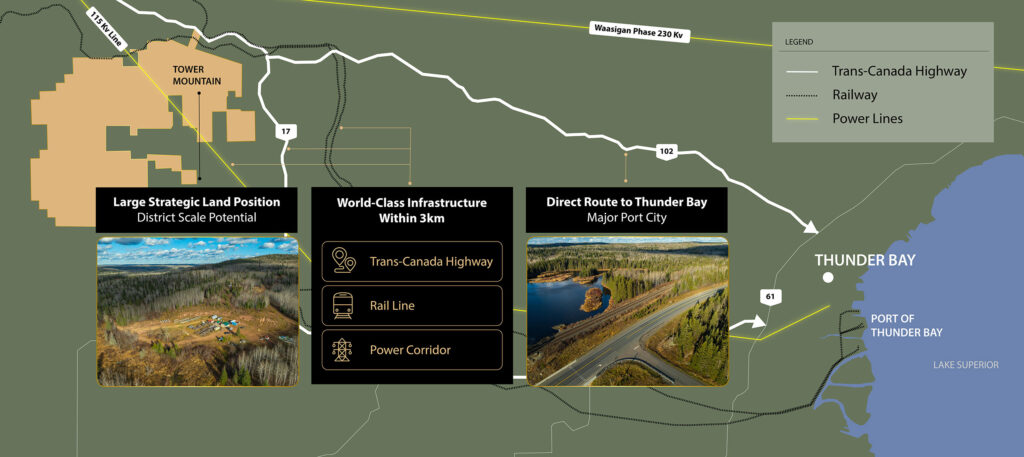
Tower Mountain surrounds the Tower Mountain Intrusive Complex, described by the Company as the largest exposed calc-alkalic intrusive complex in the eastern Shebandowan Greenstone Belt. Less than 20 percent of the complex perimeter has been drilled, mostly along the western contact.
The remaining 75 to 80 percent shows what the Company describes as identical geology, alteration and geophysical response. That similarity is the basis for expecting more mineralisation rather than a one-off occurrence, and it is the reason a resource expansion programme can be planned with specific targets rather than general optimism.
03
Magnetic Lows and CSC Alteration: The Exploration Vector
Gold at Tower Mountain is hosted in carbonate-sericite-chlorite alteration that extends more than 500 m west of the intrusive contact and remains open in that direction. The alteration destroyed magnetite, producing broad magnetic lows that are visible in geophysical data and act as a map-scale vector toward prospective rock.
Because pyrite correlates directly with gold grade, magnetic lows combined with pyrite-bearing altered rock give the team a repeatable targeting method. That is what makes resource expansion at Tower Mountain systematic: the vector can be mapped before a rig moves.
04
The P-Target, 1,500 Metres East
The P-Target sits on the eastern contact, roughly 1,500 m east of the western drilling that supports the current estimate. Drilling there returned grades and interval lengths the Company reports as statistically indistinguishable from the 235-hole, 47,000 metre western dataset.
In plain terms, the eastern contact behaves like the western one. For resource expansion that matters more than any single intercept, because it suggests the mineralised system is larger than the footprint currently modelled.
05
The 2026 Programme
The 2026 programme is budgeted at 15,000 to 25,000 metres of infill and expansion drilling with two jobs. Infill holes inside and immediately around the current pit shell aim to move Inferred tonnes into the Indicated category. Step-out and exploration holes test untested contacts and new targets that are not in any category.
The Company is targeting an updated mineral resource estimate in the fourth quarter of 2026, with 1.5 Moz Indicated and 3.5 Moz Inferred as the stated objective, and an initial Preliminary Economic Assessment for late 2026 or early 2027.
Infill metres are the least glamorous part of resource expansion and the most valuable to a resource category. Every fence of holes that halves the spacing between drill lines reduces the uncertainty used to classify tonnes, which is why the programme is described as definition and expansion rather than exploration alone.
Those are stated targets rather than outcomes. Resource expansion depends on assays, and assays arrive when the laboratory releases them.
06
Recent Intercepts Behind the Case
The 2026 newsflow has been dominated by long, low-grade intervals with the occasional very high-grade result, which is typical of this style of deposit. Reported examples include 661.5 m at 0.554 g/t Au on August 11, 2026 and 228.5 m at 0.557 g/t Au in hole TM21-107X on August 17, 2026.
Long intervals support resource expansion because they add tonnage across a wide area rather than a point. Every hole that returns a continuous mineralised run along an untested contact adds material the current model does not contain.
Drill spacing, not drilling volume alone, is what converts Inferred tonnes into the Indicated category.
Questions
Frequently Asked Questions
It means drilling ground outside the current resource outline to add tonnes and ounces. The January 2026 estimate covers about 1,800 m of one contact, while less than 20 percent of the complex perimeter has been tested.
The stated company target is 5 Moz by the end of 2026, against roughly 3.5 Moz in the January 19, 2026 estimate. It is a target, not a resource, and it depends on drilling results.
A target on the eastern contact of the intrusive complex, about 1,500 m east of the western drilling. Grades and interval lengths there are reported as statistically indistinguishable from the western dataset.
15,000 to 25,000 metres of infill and expansion drilling, an updated mineral resource estimate targeted for Q4 2026 and an initial PEA targeted for late 2026 or early 2027.
It depends on drilling metres and assay turnaround. The 2026 programme is funded and results are released as assays arrive, which is why the Company targets an updated estimate in Q4 2026.
Follow the drilling as it is released
Intercepts are published with hole numbers and release dates, which is what resource expansion ultimately rests on.
Prepared by Thunder Gold Corp. Statements about mineral resources refer to the January 19, 2026 NI 43-101 estimate by Micon International Limited. Mineral resources are not mineral reserves and have not demonstrated economic viability. Targets are not resources. Last updated: 2 November 2026.