
Tower Mountain Development: PEA, Studies and Permitting
Development · Studies and permitting
Tower Mountain development is at the study stage. A resource estimate is complete, a preliminary economic assessment is targeted for late 2026 or early 2027, and pre-feasibility follows. This page explains what each study does, what permitting in Ontario requires, and what the Company has and has not claimed.
Q4 2026
targeted resource update
Q4 2026–Q1 2027
targeted initial PEA
1.8:1
strip ratio in the resource model
01
Where Tower Mountain Development Sits on the Study Ladder
Tower Mountain development follows the standard ladder: studies build on each other, and each one raises confidence rather than certainty. A mineral resource estimate states tonnage and grade. A preliminary economic assessment adds a first mine concept and conceptual economics. A pre-feasibility study refines the design and costs, and a feasibility study supports a construction decision.
Tower Mountain development has completed the first step: the January 19, 2026 estimate by Micon International Limited reports 34.0 Mt Indicated at 0.46 g/t Au and 211.1 Mt Inferred at 0.45 g/t Au, about 3.5 Moz. Everything beyond that is planned rather than published.
02
What a PEA Does and Does Not Prove
A preliminary economic assessment is conceptual. It can use Inferred resources, which a pre-feasibility study cannot rely on in the same way, and it is preliminary in the technical sense of the word: it describes a scenario rather than a commitment.
For Tower Mountain development, the PEA will test whether the modelled pit, the metallurgy and the cost assumptions hold together. It does not grant a permit, raise money or remove geological risk, and its conclusions depend on the gold price, recovery and strip ratio used.
It is also where the strip ratio, cut-off grade and recovery assumptions from the resource model are tested against an actual mine design rather than a pit optimisation.
03
From PEA to Pre-Feasibility and Feasibility
Pre-feasibility work is expected in 2027 or later. That stage requires tighter drilling, more metallurgical testwork and engineering design at a defined accuracy, and it is the point at which mineral resources can begin to convert into mineral reserves.
Metallurgy is already partly de-risked. Sixteen samples tested at Bureau Veritas in 2022 and SGS Canada in 2025 returned gold recoveries of 68 to 94.9 percent, averaging about 85 percent, with a Bond work index near 20 kWh/t and a Net Neutralizing Potential of 76.5 kg CaCO3 per tonne.
Those figures support the 80 percent recovery assumption used in the resource model, which sits below the 85 percent average measured in testwork.
04
Permitting in Ontario
Ontario permitting runs through the Mining Act, with defined regulatory steps that depend on the size and type of operation. Exploration on Crown land also brings consultation duties, including with First Nations, and the Tower Mountain property lies in the traditional territories of Fort William First Nation.
For Tower Mountain development, permitting is a future stage rather than a current one. No construction decision has been made and no permit application for a mine has been filed. The work now is technical: drilling, metallurgy and study preparation.
Ontario also requires closure planning and financial assurance at the mine stage, and the permitting timeline for a large open pit is measured in years rather than months. At Tower Mountain development stage none of that work has started.
05
Location and Infrastructure
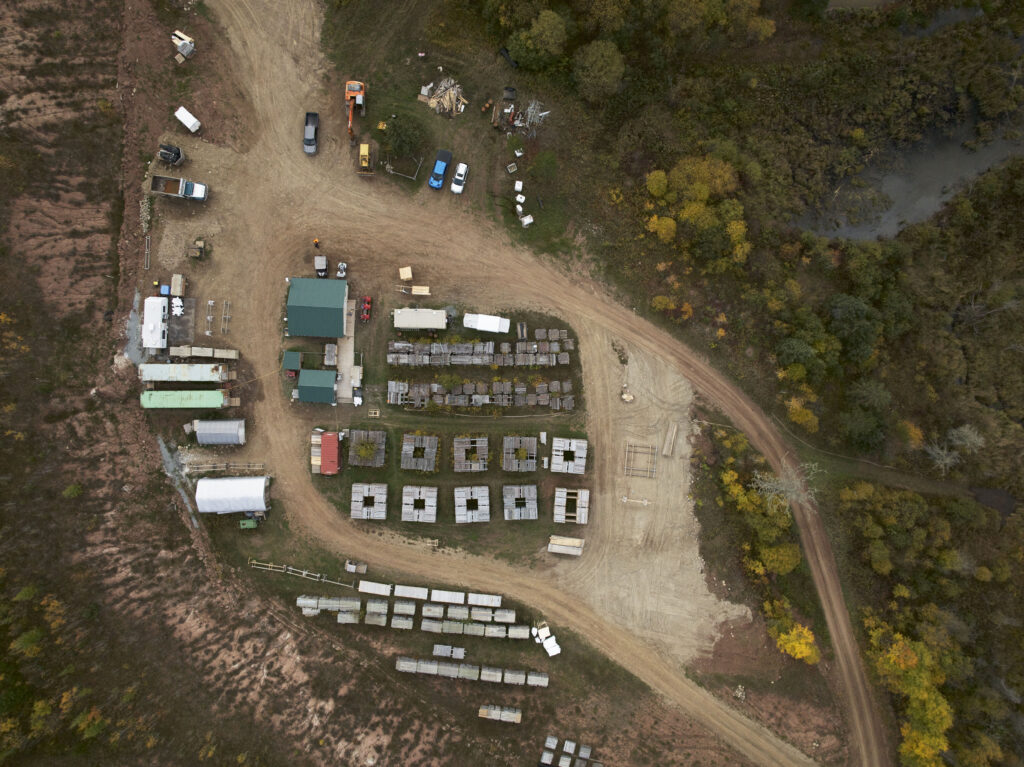
Infrastructure shapes Tower Mountain development economics as much as grade does. The Tower Mountain property boundary lies about 3 km south of the Trans-Canada Highway 11/17, roughly 40 km west of Thunder Bay, with rail and power corridors 3 to 5 km away and the international port of Thunder Bay offering Saint Lawrence Seaway access.
A workforce can live in a city of about 110,000 people rather than in a camp, and the Company reports all-in drilling costs of about C$250 to C$275 per metre. For any future Tower Mountain development, those are advantages that cannot be replicated by a remote project.
06
What the Company Has Stated
The Company is targeting an updated mineral resource estimate in Q4 2026 with 1.5 Moz Indicated and 3.5 Moz Inferred as the objective, and an initial PEA in Q4 2026 or Q1 2027. Those are targets, not outcomes, and the schedule depends on assay turnaround and study work.
What Tower Mountain development has not produced is a reserve, a mine plan or a production forecast. Mineral resources are not mineral reserves and do not have demonstrated economic viability.
A preliminary economic assessment is prepared or supervised by independent qualified persons and filed, so its assumptions can be checked against the resource model.
Questions
Frequently Asked Questions
An initial preliminary economic assessment is targeted for Q4 2026 or Q1 2027, following an updated mineral resource estimate targeted for Q4 2026.
No. Permitting in Ontario runs through the Mining Act and is a future stage of Tower Mountain development. No construction decision has been made and no mine permit application has been filed.
80 percent, below the 68 to 94.9 percent range measured in testwork on 16 samples, which averaged about 85 percent.
A PEA is conceptual and can rely on Inferred resources. A feasibility study is an engineering-level assessment that establishes reserves and supports a construction decision. Pre-feasibility sits between them.
A mine requires approvals under the Mining Act together with environmental approvals, closure planning and financial assurance, plus consultation with First Nations. None of those applications has been filed for Tower Mountain.
Read the estimate the studies build on
The resource estimate is the foundation for the PEA and for every study that follows it.
Prepared by Thunder Gold Corp. Statements about mineral resources refer to the January 19, 2026 NI 43-101 estimate by Micon International Limited. Mineral resources are not mineral reserves and have not demonstrated economic viability. Targets and study timing are not commitments. Last updated: 2 November 2026.