
Gold Mineral Exploration Guide | Thunder Gold Corp
Start here · The exploration process
Gold exploration is a sequence of measurements, not a single discovery moment. This guide explains the stages in order, what each one costs in time and money, and what a reader should look for before believing a headline result.
7 stages
from ground selection to resource estimate
235 holes
drilled at Tower Mountain to date
3.5 Moz
contained gold defined so far
01
What Gold Exploration Actually Is
Gold exploration is the business of finding, measuring and proving mineralisation without mining it. A company acquires the right to explore ground, tests what is under the surface, and reports the results under rules that make the numbers comparable between companies.
In Canada those rules are NI 43-101: technical reports must be prepared or supervised by Qualified Persons, and public statements about resources must trace back to filed documents. That is why a gold mineral exploration company can publish a grade but not a revenue forecast.
Most junior explorers never build a mine. Success can mean defining a resource that a larger company acquires or develops, which is why the quality of the technical record matters more than the ambition of the press release.
02
The Seven Stages, In Order
Each stage exists to reduce uncertainty before the next, more expensive stage is funded. Skipping forward is how budgets are wasted on targets that were never worth drilling.
The sequence below is standard, though companies compress or repeat steps as results dictate.
Costs rise by orders of magnitude as a project moves down that list. Mapping and sampling are cheap, airborne surveys are cheap per hectare, drilling is expensive per metre, and a resource estimate only becomes meaningful once the dataset behind it is large enough to support a classification.
Ground selection, staking or optioning, and title verification.
Historical data compilation: government maps, assessment files, old drill logs.
Mapping and prospecting to find altered or mineralised rock at surface.
Geochemical sampling of soil, till and rock to narrow the target.
Geophysical surveys to map structure, alteration and magnetic response.
Diamond drilling to test the target at depth and recover core.
Assaying under a QA/QC programme, then an independent resource estimate.
03
From Target to Mineral Resource
A target becomes a resource only when enough holes have been drilled at close enough spacing for a qualified person to estimate tonnage and grade with stated confidence. The estimate is then classified as Measured, Indicated or Inferred, depending on the evidence behind it.
At Tower Mountain, the January 19, 2026 estimate by Micon International Limited reports 34.0 Mt Indicated at 0.46 g/t Au and 211.1 Mt Inferred at 0.45 g/t Au, about 3.5 Moz. No Measured resources are reported, and none of it is a reserve.
Mineral resources are not mineral reserves and do not have demonstrated economic viability. The distinction is not a technicality: it separates a geological estimate from a mineable, permitted, funded project.
04
What Exploration Cannot Do
Gold exploration cannot create grade, and it cannot turn a resource into a reserve without engineering, permitting and money. It also cannot remove market risk: a company may define a deposit and still fail to fund its development.
What good exploration can do is reduce geological uncertainty in a documented, repeatable way. That is why the record matters more than the story: hole numbers, assay certificates, QA/QC results and independent reports are what a reader can check.
05
Reading a Result Without Being Misled
Three habits prevent most misreadings. First, check whether a reported interval is a composite above a stated cut-off rather than a single assay. Second, check the category: Indicated tonnes and Inferred tonnes carry different confidence. Third, check who prepared the estimate and whether it is filed.
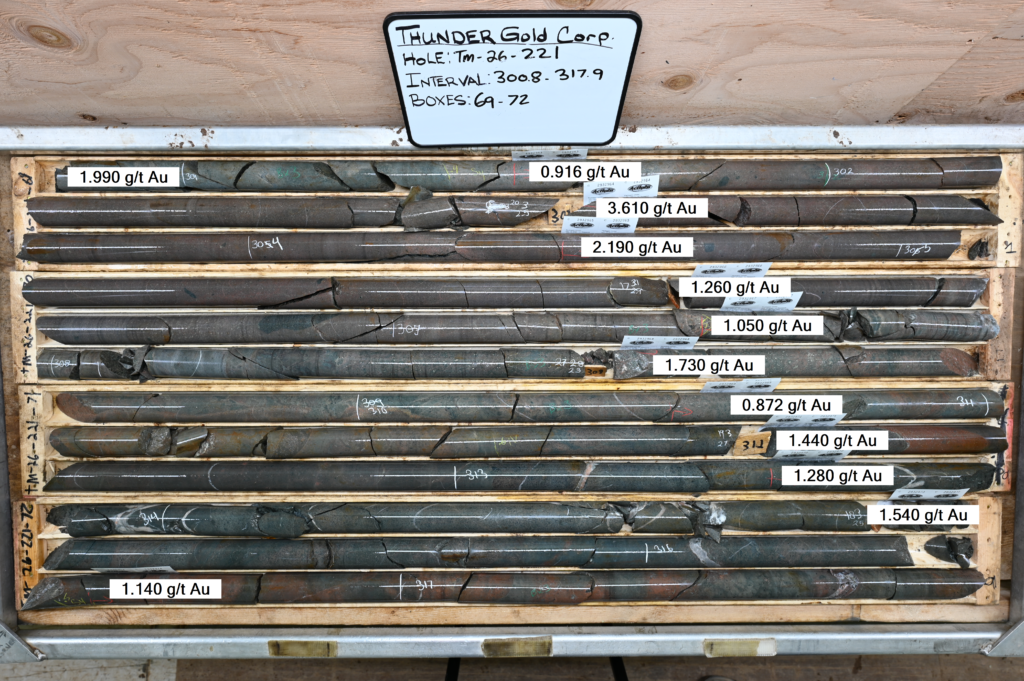
A long, low-grade intercept and a short, very high-grade intercept can both be accurate and mean different things. At Tower Mountain, 1.7 g/t Au over 250.4 m and 941.0 g/t Au over 1.5 m came from the same deposit and describe different parts of it.
06
Where to Go Next
If you want the methods in detail, start with the gold exploration methods page, which covers fire assay and QA/QC. If you want the drilling, the drilling guide walks through core recovery and how an intercept is built.
For the Company side, the investor relations hub collects the filings, and the resource estimate page carries the numbers in full.
Every stage leaves a document behind: a map, a survey, an assay certificate, a technical report. That record is what makes an exploration claim checkable.
Questions
Frequently Asked Questions
The process of finding and measuring gold mineralisation without mining it: acquiring ground, mapping and sampling it, running geophysical surveys, drilling and assaying, then commissioning an independent mineral resource estimate.
Years rather than months for a project to reach a resource estimate. Each stage depends on the previous one, and drilling programmes are usually seasonal or budget-dependent.
A mineral resource is a geological estimate of tonnage and grade with stated confidence. A mineral reserve is the part of a resource that a study has shown can be mined economically. Resources are not reserves.
The Canadian standard for disclosure of mineral projects. It requires technical reports prepared or supervised by Qualified Persons and public filing of the supporting documents.
Junior explorers raise capital from investors, often through flow-through shares in Canada, and may option or joint-venture ground to spread risk. Exploration companies generally earn no revenue until a project is sold or developed.
Keep reading
Related Pages
Follow the sequence at one project
Tower Mountain shows the stages in practice, from airborne surveys to a filed resource estimate.
Prepared by Thunder Gold Corp. Statements about mineral resources refer to the January 19, 2026 NI 43-101 estimate by Micon International Limited. Mineral resources are not mineral reserves and have not demonstrated economic viability. Last updated: 2 November 2026.