
Gold Exploration Drilling: From Diamond Bit to Drill Intercept
Drilling · Tower Mountain, Ontario
Gold exploration drilling is how a geological idea becomes a number a reader can check. This page follows a hole from the diamond bit to the assay certificate and explains how an intercept is built, what the QA/QC programme protects, and which results at Tower Mountain came from which kind of interval.
941.0 g/t
highest grade reported, over 1.5 m
250.4 m
at 1.7 g/t Au, bulk interval in TM23-139
15,000–25,000 m
drilling planned for 2026
01
Gold Exploration Drilling: Diamond Core and How It Works
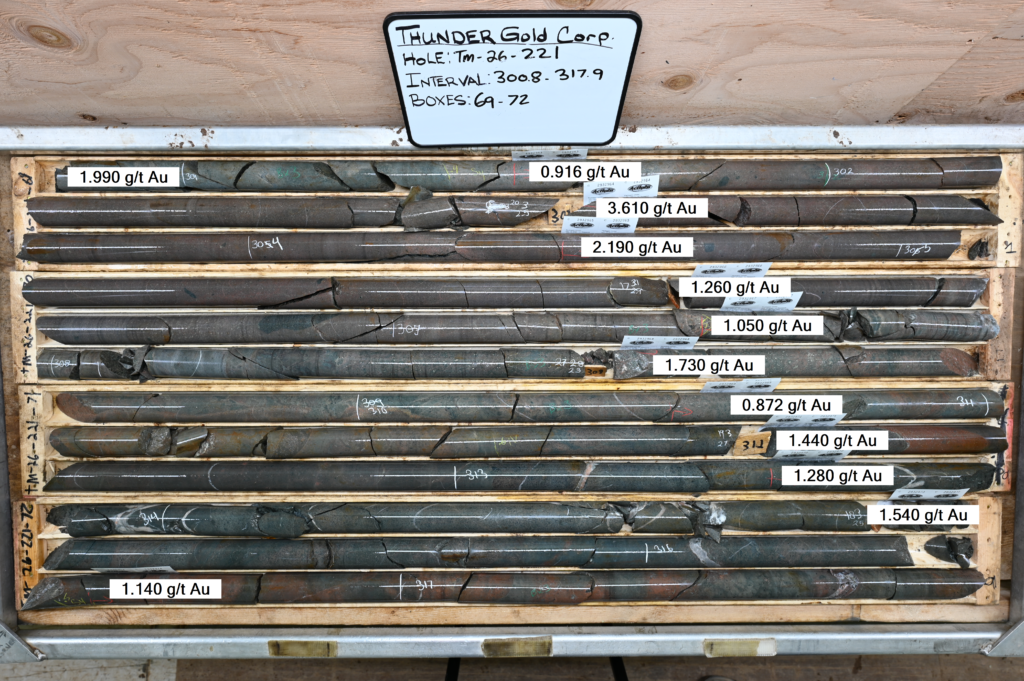
Most gold exploration drilling in Ontario uses diamond core rather than the cheaper reverse circulation rigs seen in other jurisdictions. A diamond drill turns a hollow steel bit impregnated with industrial diamonds to cut a cylindrical core, typically NQ or HQ diameter, from the rock. The core comes to surface in runs, is logged by a geologist, marked for sampling and photographed.
The advantage is that diamond core preserves the structure and texture of the rock, and in shear-hosted gold systems that context matters as much as the assay.
02
Core Recovery, Logging and Sampling
A hole is only as good as the data it produces, and core recovery is the first test. If the core crumbles in a fracture zone, the geologist has a gap exactly where the data may matter most. Recovery is recorded as a percentage, and poor intervals are flagged when the resource estimate is built.
Logged core is split with a diamond saw. One half goes to the laboratory, the other is stored in a core shed for reference, which is what allows a later reviewer to re-check a reported interval. Representative core from the Tower Mountain programme is published in the core images gallery.
03
Gold Exploration Drilling QA/QC: The System Behind the Numbers
Every assay that feeds a news release or a resource estimate arrives with a QA/QC programme, because a laboratory can produce a wrong number and no system catches it automatically. Gold exploration drilling programmes insert blanks, certified standards and duplicates into the sample stream, typically every twentieth sample.
A blank that returns gold means contamination; a standard that drifts means calibration has slipped; a duplicate that disagrees means the sampling was uneven. When a control fails, the batch is re-assayed. The Qualified Persons who signed the January 19, 2026 Micon International estimate — William Lewis, P.Geo., Charley Murahwi, P.Geo., FAusIMM, and Tudorel Ciuculescu, P.Geo. — reviewed that data before it entered the resource model.
04
From Assay to a Reported Intercept
Gold is measured by fire assay with an ICP or gravimetric finish: the sample is fused with flux, the lead button is collected and the gold content measured, with results reported in grams per tonne over the sampled interval.
A reported intercept is not a raw assay. It is a composite: the company chooses a cut-off grade, typically 0.1 to 0.5 g/t Au for a bulk-tonnage system, and reports the down-hole length over which grade averages above that cut-off, allowing narrow higher-grade intervals inside it. Two intervals from the same deposit can therefore look completely different and still be honest, which is why gold exploration drilling results should be read with the cut-off and the geology in view.
05
Reading the Tower Mountain Intercepts
The highest grade reported from gold exploration drilling at Tower Mountain was 941.0 g/t Au over 1.5 m in hole TM23-137, a narrow vein. The bulk system shows up differently: TM23-139 returned 1.7 g/t Au over 250.4 m, TM23-140 returned 5.3 g/t Au over 24.5 m and TM23-143 returned 5.9 g/t Au over 36.3 m.
The October 2026 releases continued the pattern, including 336.0 m at 0.407 g/t Au and 290.1 m at 0.527 g/t Au in the same release. Long low-grade intervals and short high-grade intervals describe different parts of one system, and both matter to a geologist building a resource model.
The 2026 programme of 15,000 to 25,000 m of infill and expansion drilling is designed to convert Inferred material toward Indicated and to test extensions beyond the current resource outline.
06
What Drilling Proves and What It Does Not
In gold exploration drilling, a hole proves that mineralisation exists at one point, at one angle, over one sampled length. It does not prove continuity between holes, and it does not prove that the material can be mined economically. Those conclusions require enough drill spacing to support a resource classification, and then engineering studies on top.
That is why gold exploration drilling is reported in phases: infill holes to tighten spacing, expansion holes to extend the outline, and metallurgical or geotechnical holes to answer separate questions.
Questions
Frequently Asked Questions
The use of drill rigs, usually diamond core rigs, to recover rock from depth so it can be logged, sampled and assayed. It is the step that turns a geological target into measured grade over a known interval.
Diamond core preserves the structure and texture of the rock, which matters in shear-hosted gold systems where the relationship between mineralisation and host rock controls grade. Core can also be re-checked later from the core shed, which is why gold exploration drilling is reported with hole numbers and depth intervals.
It is a composite length and grade calculated above a stated cut-off, not a single assay. A company reports the down-hole length over which grade averages above the cut-off, allowing narrower higher-grade intervals inside it.
No. A drill intercept proves mineralisation at one point. Building a mine requires a mineral resource, engineering studies, permitting and financing, and mineral resources are not mineral reserves.
Read the holes behind the headline
Every intercept cited on this page is listed with its hole number and release date on the drill results page.
Prepared by Thunder Gold Corp. Statements about mineral resources refer to the January 19, 2026 NI 43-101 estimate by Micon International Limited. Mineral resources are not mineral reserves and have not demonstrated economic viability. Last updated: 2 November 2026.