
Gold Exploration – Index (Thunder Gold Corp)
Exploration · Start here
Gold exploration runs in a sequence, and each stage answers a narrower question than the one before it. This section explains the process from ground selection to resource estimate, the methods behind each step, and the districts where Thunder Gold works.
7 stages
from staking to resource estimate
47,000 m
drilled at Tower Mountain to date
3.5 Moz
contained gold defined so far
01
The Guides in This Section
Each page below covers one part of the process in enough detail to be useful on its own, and they are written to be read in order or picked up individually.
The overview explains the full sequence. The methods page covers surveys, sampling and assaying. The drilling page follows a hole from the bit to the reported intercept. The remaining pages cover companies, Ontario, Thunder Bay and junior explorers.
Gold exploration explained: the seven stages in order.
Gold exploration methods: surveys, sampling and assaying.
Gold exploration drilling: from diamond bit to intercept.
Gold exploration companies in Canada: a due diligence framework.
Gold exploration in Ontario and near Thunder Bay.
Junior gold exploration companies: how they work and how to check them.
02
Why the Order Matters
Gold exploration is expensive in the order it is done, cheapest first. Mapping and sampling cost little compared with geophysics, and geophysics costs a fraction of drilling. Doing the cheap work first is not caution for its own sake: it is how a company avoids drilling targets that were never worth testing.
A target that survives mapping, geochemistry and geophysics has earned a drill hole. A target that skips those steps is a guess with a budget attached, and the record of the sector is full of them.
03
Methods: Measuring Rather Than Guessing
Every number in a resource estimate comes from a measurement, and measurements can fail. Fire assay can be contaminated, a survey can mislead, a sample can be unrepresentative. That is why gold exploration methods are paired with QA/QC programmes that insert blanks, standards and duplicates into the sample stream.
The methods page explains fire assay and ICP finishes, the QA/QC programme, geochemical sampling and the geophysics that maps alteration before a rig moves.
04
Drilling and Reporting
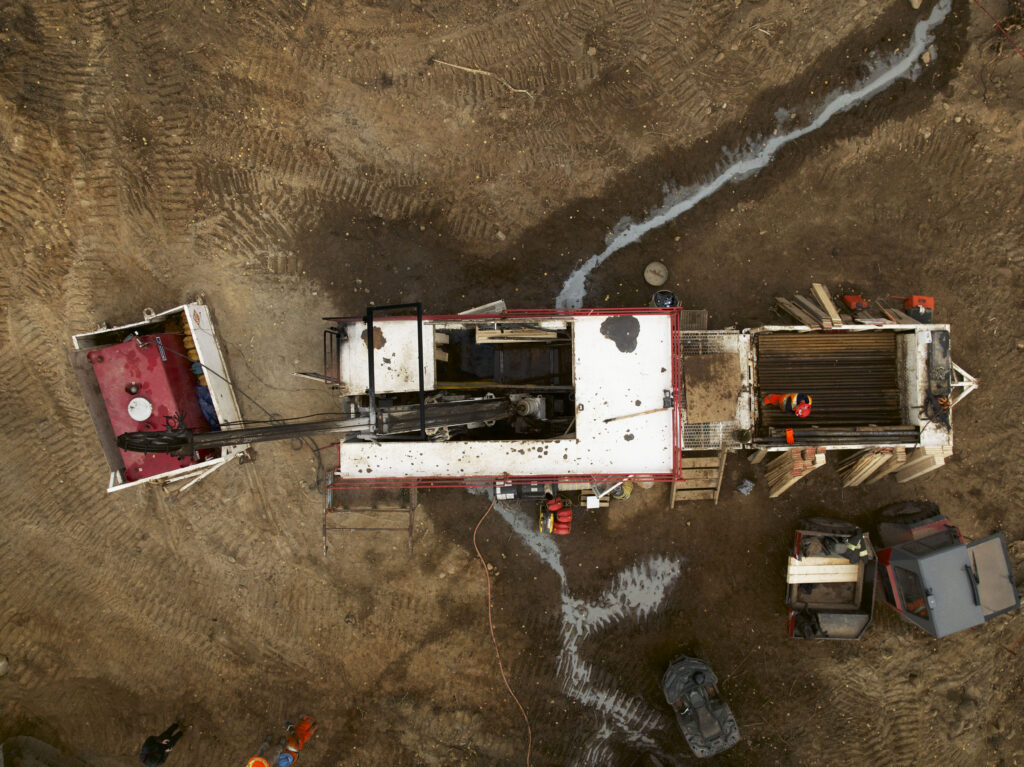
Drilling is the only step that proves what is at depth. The drilling guide covers core recovery, logging, sampling and the difference between a raw assay and a reported composite above a stated cut-off.
It also explains why a long low-grade interval and a short high-grade interval can both be accurate. At Tower Mountain, 1.7 g/t Au over 250.4 m and 941.0 g/t Au over 1.5 m came from the same deposit and describe different parts of it.
05
Districts: Ontario and Thunder Bay
Jurisdiction shapes cost and timeline as much as geology does. Ontario combines Archean greenstone belts, a defined permitting path under the Mining Act and provincial exploration funding, which is why the province hosts so many listed explorers.
Thunder Bay adds infrastructure: a city of about 110,000 people, a Trans-Canada Highway corridor, rail and power lines, and an international port with Saint Lawrence Seaway access. Thunder Gold’s Tower Mountain project sits about 40 km west of the city.
06
Where to Start
Readers new to the sector should start with the overview and then the methods page. Anyone comparing companies should go to the due diligence framework, which sets out the checks that separate a documented project from a promotional one.
For the Company’s own numbers, the resource estimate page carries the tonnages, grades, cut-off and assumptions in full.
07
The Estimate Is the Goal, Not the Start
A mineral resource requires more than interesting drill results. It needs enough holes at close enough spacing, a validated assay database, a geological model that constrains the estimate, and an independent qualified person to sign it. Classification then depends on spacing and data quality, which is why converting Inferred tonnes to Indicated is a drilling problem rather than a reporting one.
That is also why a company can report excellent intercepts for a year without the resource changing much. Intercepts add information; spacing adds confidence.
08
Costs Rise With Each Stage
Mapping and sampling are inexpensive. Airborne geophysics is moderate. Drilling is expensive per metre, and a resource estimate requires enough drilling to be meaningful. Companies sequence the work so that cheap answers come before expensive ones, and a programme that skips stages usually reveals itself in the budget rather than the geology.
The section is written to be read in order, but each page stands on its own for a reader who arrives from a search result.
Questions
Frequently Asked Questions
The full sequence of gold exploration: the stages in order, the methods used to measure grade, how drilling works, how companies are compared, and the Ontario and Thunder Bay setting.
Gold exploration explained, which sets out the seven stages. From there, the methods and drilling pages go into detail.
The explanations are general, with Tower Mountain used as the worked example throughout. Company-specific figures come from the January 19, 2026 NI 43-101 estimate by Micon International Limited.
No. Most exploration projects never become mines. Mineral resources are not mineral reserves and do not have demonstrated economic viability.
Years for most projects. It depends on how much drilling is needed to reach the required spacing, how quickly assays return, and whether the geology cooperates with the model.
Keep reading
Related Pages
Follow the sequence at Tower Mountain
The project page shows the same stages in practice, from airborne surveys to a filed resource estimate.
Prepared by Thunder Gold Corp. Statements about mineral resources refer to the January 19, 2026 NI 43-101 estimate by Micon International Limited. Mineral resources are not mineral reserves and have not demonstrated economic viability. Last updated: 2 November 2026.